

Unleash your brain's FULL POTENTIAL

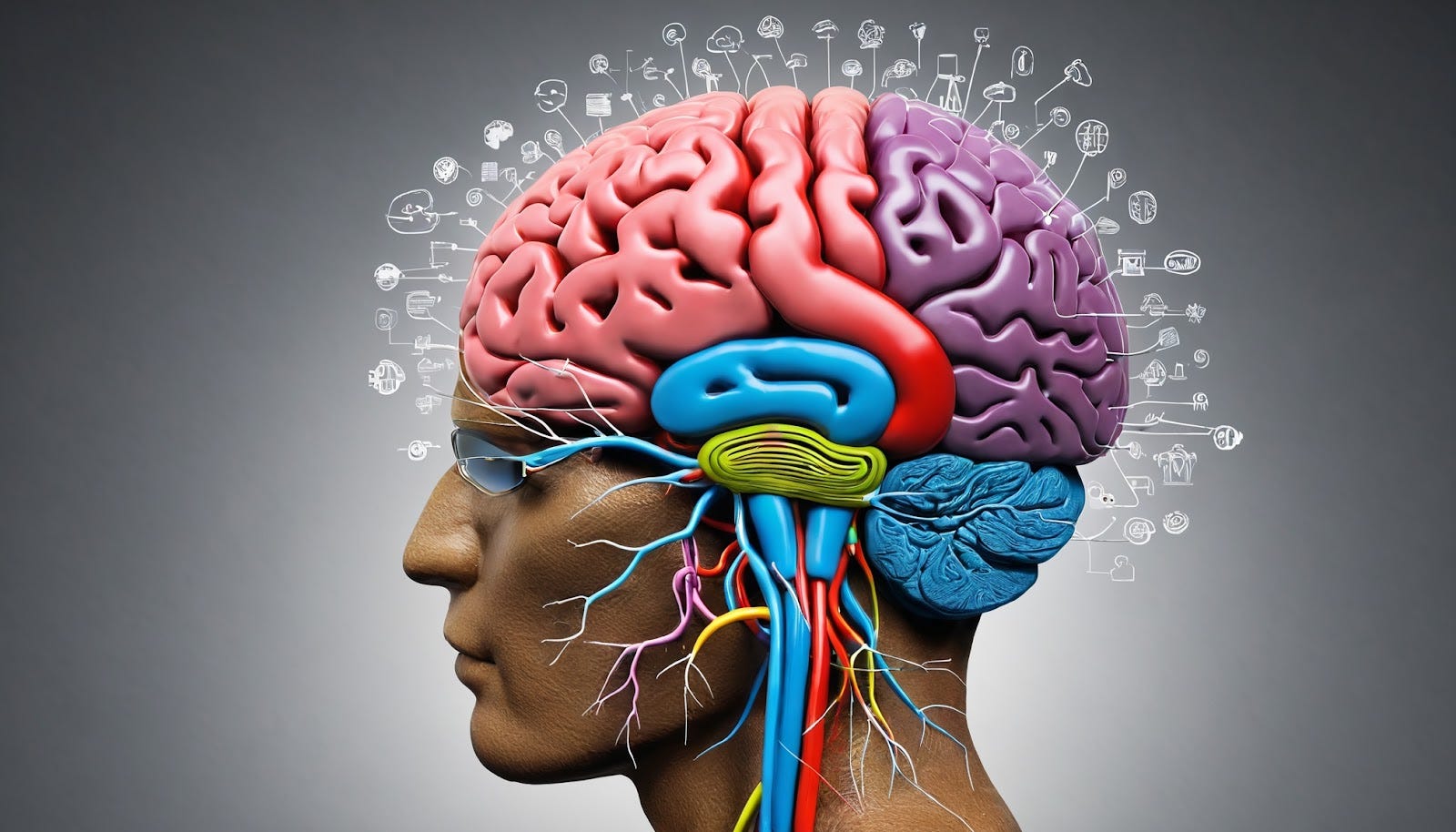
Everyone's born with the same brain, right?
All brains have 100 billion neurons. So why are some brains more capable than others?
Some people are able to focus more, be more creative, while others procrastinate and struggle with everyday tasks.
Why is there so much difference? The good news is that because of neuroplasticity, anyone at any age can learn skills that can make them as good as anyone else.
So, the prefrontal cortex (PFC) in your brain is the most evolved part of the brain, and it is responsible for some very important tasks like planning your future, sustaining attention, or even calculating the risk of something bad happening to you.
So if you want to train your brain to become more productive, you are actually training your prefrontal cortex.
Let's understand five things that your prefrontal cortex does and how you can improve each one of them.
1. Goal-directed behavior:
The prefrontal cortex, specifically a part called the frontopolar area, is responsible for planning ahead. This part has the job of planning what you will do later and also predicting how you will do it. The key word here is prediction. The better you are able to predict your own behavior, the stronger your prefrontal cortex gets.
How to improve it:
Add a timer to your to-do list and predict how long each task will take.
Over time, you’ll get better at planning your day and sticking to your goals. This simple exercise helps your PFC become more efficient at anticipating future actions.
2. Pattern Recognition
Your PFC has the job of quickly analyzing a situation, breaking it down into smaller parts, and putting it together to understand a situation in its own way.
How to improve it:
Engage in activities like solving jigsaw puzzles, Rubik’s Cubes, Sudoku, or crossword puzzles.
These games exercise your brain’s ability to recognize and process patterns, which can keep your mind sharp. Research shows that people who regularly do puzzles have a later onset of memory problems like dementia and Alzheimer’s.
3. Language and Communication
The Broca’s area, located in the PFC, is responsible for processing language—whether it's figuring out the right words to say or structuring your thoughts. Strong language skills reflect a well-trained prefrontal cortex.
How to improve it:
Practice journaling or creative writing. The act of turning complex thoughts into words strengthens Broca’s area.
Speak up in conversations, teach others, or engage in public speaking. Every time you articulate a thought or explain something complex, you’re strengthening the language center of your brain.
4. Inhibition: The Power to Say No
One of the most valuable skills the PFC offers is the ability to inhibit impulses. Your limbic system—the more primal part of your brain—often seeks immediate gratification. It’s the PFC that steps in to say “no” and keep you focused on long-term goals.
How to improve it:
Practice saying "no" to small temptations. For example, take a walk through a store and leave without buying anything, or eat just one chip instead of the whole bag.
The more you practice self-restraint in everyday situations, the easier it becomes for your PFC to manage impulses and distractions. Over time, you’ll notice a significant boost in your self-control.
5. Movement and Focus
Your PFC controls not only your body’s movements but also the direction of your gaze. Training these movements can improve focus and help strengthen the PFC’s control over your attention.
How to improve it:
Try the candle exercise. Light a candle, place it in front of you, and focus on the flame without letting your eyes wander. The longer you can maintain your gaze, the stronger your attention networks will become.
For body movement, engage in regular physical exercise. Even simple actions like walking can stimulate dopamine, the “motivation” chemical in your brain. When you’re feeling unmotivated, get up and walk for a minute. The act of moving can spike your dopamine levels and reignite your focus.
When it comes to your body's movement and your primary motor cortex, all forms of physical exercise help build those networks.
Now here's a very important point that I wanted to share with you: all movement is based on dopamine spikes.
Now you know that dopamine is the pleasure or motivation chemical.
So here is a very simple hack for anytime you feel that you are low on motivation: just get up, walk for a minute, swinging your arms, and come back and sit. See if your motivation level has changed. What happens is just by the act of movement, the dopamine levels in your brain go up, and you will feel more motivated than you did before. I call this the kickstarter strategy.
I compare it to kickstarting a scooter that wouldn't have started otherwise. Just by moving, you get more motivation. Try it out and tell me if this works for you.
So these are five different training techniques for you to try at home to strengthen your prefrontal cortex.
I will see you guys in the next one.
Cheers,
Sid
PS: If you are looking to learn more about Neuroscience: https://sidwarrier.com/courses
If you are looking to implement Neuroscience in your life, the next NeuroMastery cohort is in October: https://sidwarrier.com/neuromastery